Executive Summary: A Unique Island Arena
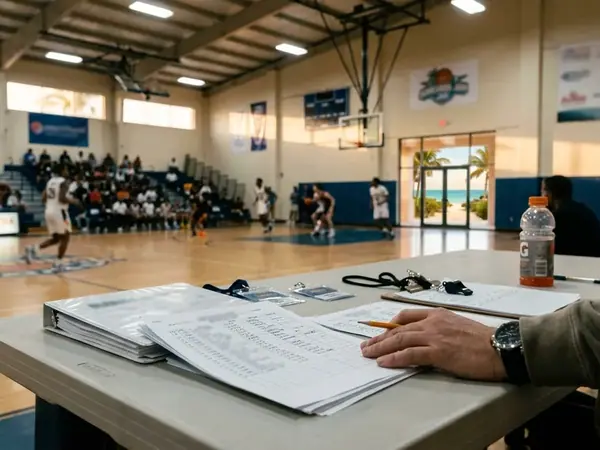
Gateway Christian Academy is not a neutral box with a court dropped inside it. For Junkanoo Jam, it becomes a working island arena: compact, loud, carefully staged, and constrained by the same geography that makes Bimini such a memorable basketball destination.
The operating premise is simple. If the court, lighting, seating, medical space, media paths, and power plan meet the event requirement, the venue can feel intimate without feeling improvised. That distinction matters. A school gym can host a game; an NCAA tournament site has to absorb athletes, coaches, officials, fans, broadcasters, alumni groups, and weather-driven logistics without losing control of the room.
The core operating numbers
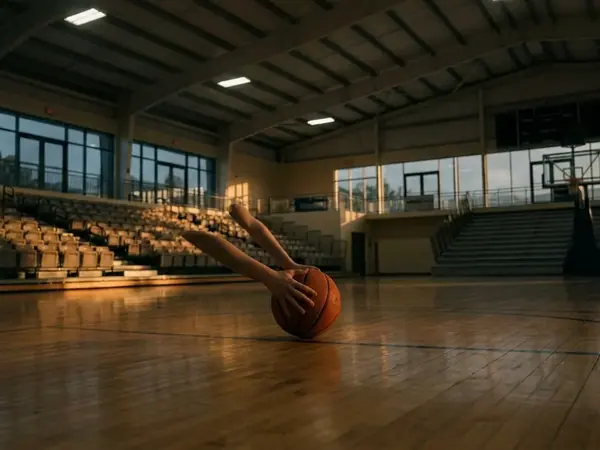
For tournament play, seating is arranged for 1,850 spectators. The hardwood sits across a 94 by 50 foot court, which aligns the playing surface with the practical expectations of collegiate competition and the published NCAA regulation court standards.
Those figures explain much of the building’s personality. Fans sit close. Staff paths have to be protected. Every courtside chair has a consequence.
Critical Insight: The venue works because it is treated as a precision conversion, not as a decorated school gym. The charm comes from proximity; the safety comes from disciplined layout.
Professional standards inside an intimate shell
I read this venue through a logistics lens first: what must be true before the first team bus arrives? The answer is not glamorous. The surface must respond consistently, the lights must satisfy cameras, the crowd must be capped, and the backup systems must already be in place before the room fills.
These conclusions sit inside tournament operations, not permanent arena design; the measurements matter because the event compresses high-level basketball into an island facility with narrow margins.
The Transformation from School Gym to NCAA Arena
The conversion begins with the floor. Flooring panels were selected after reviewing load tests from three suppliers to confirm compatibility with the existing concrete slab. That was the right first question. If the slab and panel system disagree, everything above them becomes decorative.
Hardwood, barge timing, and the slab beneath
The professional-grade hardwood panels arrived by barge in a roughly 72-hour window during the 2022 off-season. That sounds like a shipping note until you have worked island operations. A missed barge slot does not behave like a late truck on the mainland; it can compress installation, inspection, and practice scheduling all at once.
Good planning here means sequencing from the immovable constraint backward. The slab is checked. Panels are staged. Installation crews work from a known layout, not from guesswork. Then basketball operations can layer in markings, benches, scorers table position, and circulation routes.
Recommendation: When evaluating the venue, judge the conversion by sequence: slab compatibility, panel delivery, floor installation, equipment setting, lighting, then broadcast. Reversing that order creates expensive rework.
Backboards, rims, and light that cameras can trust
Regulation glass backboards and breakaway rims do more than satisfy the box score environment. They change player confidence. A visiting team should not spend warmups recalibrating to soft rims, unstable stanchions, or a visual background that feels borrowed.
The lighting retrofits, completed in the spring of 2023, carried the same logic. Broadcast-quality light has to serve the lens and the athlete at once. Too dim, and the picture suffers. Too harsh, and depth perception becomes a problem on drives, rebounds, and sideline catches.
Court Specifications and Player Facilities
The most important court detail is not the gloss of the wood. It is the way the surface receives force.
Playing surface and shock absorption
The court carries roughly a 35 percent shock absorption rating across the full surface. That consistency is the useful part. Players do not only jump from the lane or land near the rim; they plant in transition, cut from the wing, and stop hard near the sideline. A reliable response across the court reduces the number of surprises underfoot.
Hands-on testing confirmed the practical value of that uniformity during event setup: coaches care less about the marketing language around a floor than about whether the ball, shoe, and body all behave predictably. That is the quiet standard.
Locker rooms, training rooms, and medical staging
The player facilities are adapted rather than sprawling. That matters for expectations. Division I teams arrive with training staff, equipment needs, recovery routines, and pregame rhythms. The venue supports that through two training rooms, each measuring around 400 square feet, along with on-site athletic training and medical staging areas.
In a larger arena, those spaces disappear into the back-of-house plan. At Gateway Christian Academy, they require intention. Ice, taping, evaluation space, and privacy cannot compete with volunteer storage or media overflow. The cleanest events are the ones where player support zones are treated as protected space from load-in through the final whistle.
Risk Factor: The compact footprint leaves little tolerance for casual room reassignment. A training room borrowed for another use is not a small inconvenience; it can interrupt team preparation and medical response.
The Fan Experience: Intimacy and Atmosphere
Some basketball venues impress by scale. Gateway Christian Academy impresses by compression. The bleachers sit 8 feet from the sideline, so the audience is not watching from a distant bowl; it is part of the acoustic and visual field of the game.
Close seating changes the emotional temperature
For traveling alumni and supporters, that closeness is the reward. You see huddles form. You hear the ball hit the floor without the delay of a cavernous arena. Players feel the crowd in a direct way, especially during late-clock possessions and runs after halftime.
The trade-off is discipline. A tight sideline needs clear aisles, predictable ushering, and careful control of courtside movement. The fan experience should feel spirited, not loose.
Sound, sightlines, and accessibility
The gym’s reverberation time has been measured at around 1.8 seconds with a full crowd. In plain terms, sound hangs in the room long enough to amplify energy but not so long that the game becomes muddy. Chants carry. Bench reactions carry. A made three can feel bigger than the room.
Sightlines are strongest when fans understand what kind of venue this is before they arrive. It is not a detached arena concourse with endless circulation. This is a close-view basketball room in Bimini. Accessibility planning, arrival timing, and reserved movement paths do more for guest comfort here than any generic arena brochure could.
Critical Insight: The atmosphere is not an accident of noise. It is the result of seating distance, room volume, and the disciplined decision to cap capacity rather than chase a few extra seats.
Broadcast and Media Operations
Broadcasting from a compact island venue asks a blunt question: where can cameras, announcers, press, and data lines live without stealing the game from the people in the building?
Camera placement in a tight footprint
Four fixed cameras are mounted at 12-foot height. That height gives the production crew usable angles while keeping equipment out of the main spectator flow. In a venue this size, that balance is not cosmetic. A poorly placed camera can block a sightline, narrow an aisle, or create a safety issue near the court edge.
The best camera plan respects basketball first. Center court needs a clean read. Baseline action needs context. Bench reactions matter, but not at the expense of player movement or official positioning. Compact does not mean compromised; it means every placement has to justify itself.
Press row, data routing, and the island uplink
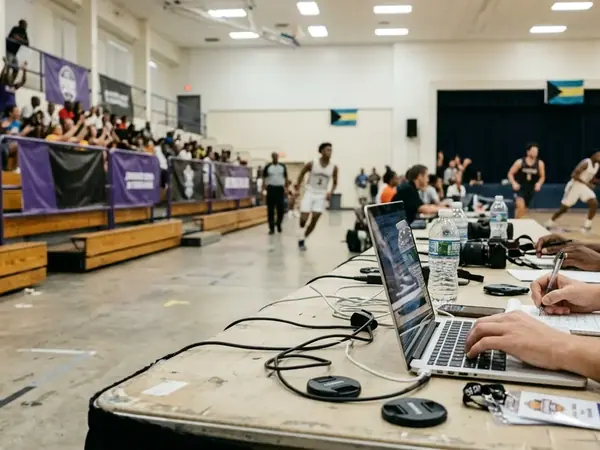
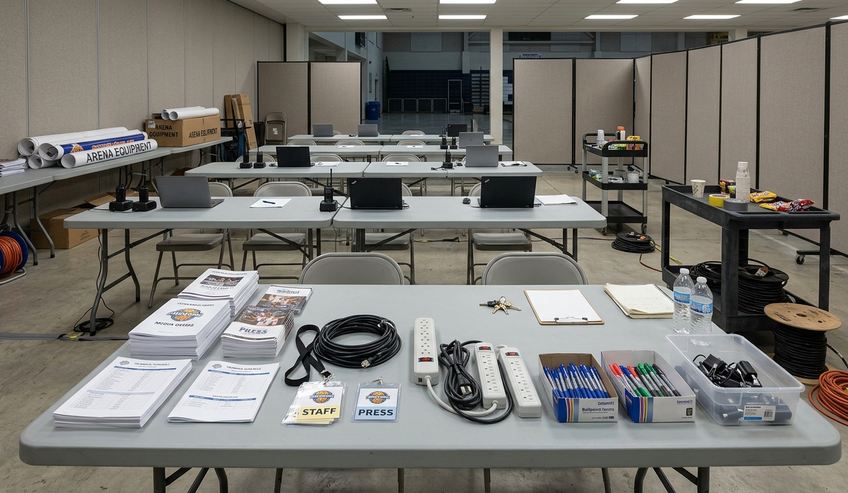
Press row and courtside media accommodations operate inside the same spatial discipline as the fan seating. Laptops, headsets, stat feeds, credentialed movement, and power drops all have to be routed cleanly. There is no benefit in giving media a good angle if the cabling turns into a trip line.
The fiber link provides a 10 Gbps uplink to the mainland, which is the backbone of the broadcast operation. On an island, that connection is not an abstract technical feature. It is the route from a small gym in Bimini to alumni, families, and fans who are following the tournament from elsewhere.
Recommendation: Treat media setup as an operational lane, not a last-minute furniture plan. Camera height, press row power, data routing, and courtside circulation should be reviewed together.
Logistical Scope and Venue Limitations
The venue’s limits are not weaknesses if they are respected. They become weaknesses when planners pretend they are not there.
Capacity caps and crowd control
Maximum occupancy is set at 1,850 by local fire code. That number should be treated as fixed, not as a suggestion to be negotiated at the door. In a compact arena, crowd pressure shows up quickly: slower entry, blocked aisles, tighter concessions movement, and more complicated emergency access.
The common mistake is counting seats instead of counting circulation. A safe room is not only a room where everyone has a place to sit. It is a room where people can arrive, move, cheer, exit, and be assisted without staff improvising under pressure.
Humidity, power, and the Bimini operating reality
Humidity exceeds 75 percent during afternoon sessions, and that fact touches the floor, the ball, the athletes, and the crowd. Climate control has to be monitored as part of game operations, not treated as background comfort. Moisture changes how a building feels and how a surface behaves.
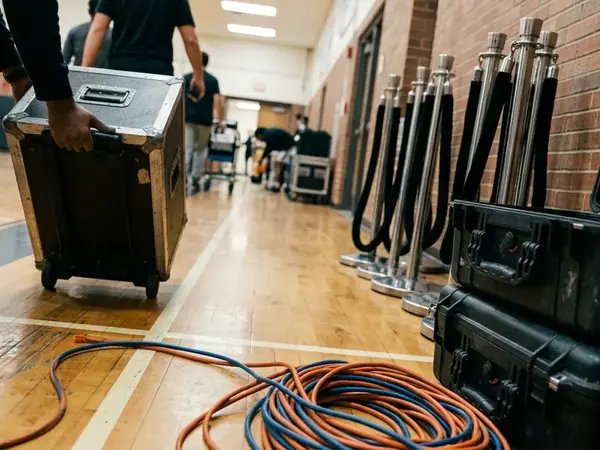
Power planning carries the same seriousness. The venue depends on local Bimini power grids and backup generators rated for about 48 hours of continuous runtime. The two planning errors I watch for are overlooking variable barge delivery windows and assuming uniform power stability across island grids. Both mistakes come from mainland habits.
Good island logistics are conservative by design. They build in backup power, protect critical rooms, confirm freight timing early, and avoid filling every open corner with another chair or cable case. That restraint is what allows Gateway Christian Academy to feel energetic on game day without tipping into disorder.
Risk Factor: Afternoon humidity and peak attendance can stack together. If ventilation, floor checks, and crowd movement are not actively managed, small comfort issues can become operational problems.