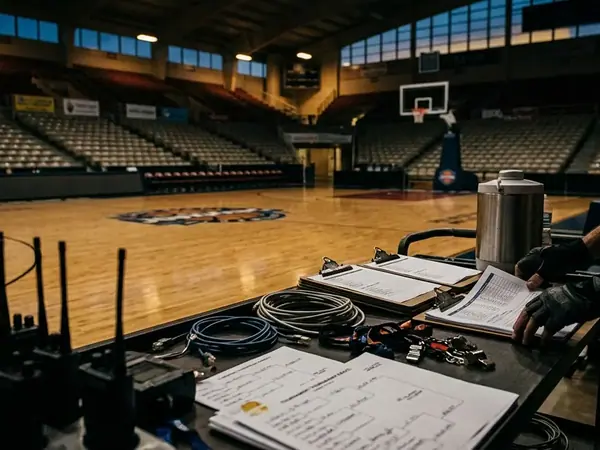
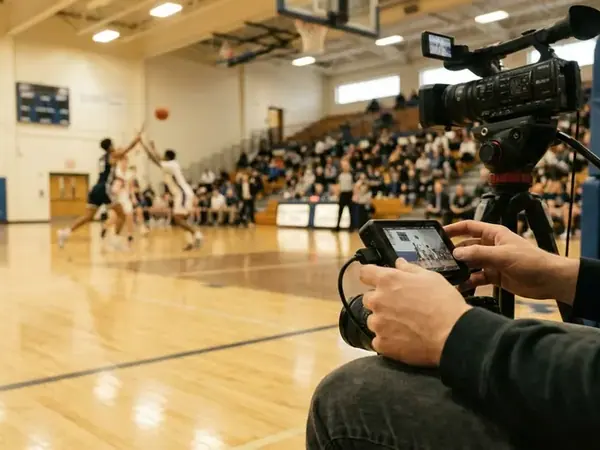
A championship crowd changes the game most when the court and the seats occupy the same small field of attention. In a compact island arena, a defender can turn a steal toward the alumni baseline and hear the response before the break reaches the other end. That closeness gives a tournament final its edge. It also gives the operations team a demanding assignment: fill the bowl, protect the aisles, and move everyone safely when the horn sounds. The island championship offers a useful way to examine both sides of that equation. Its seating plan shaped how the game felt from the first introductions through the decisive second-half run. The same plan shaped how fans entered and left. I would choose that compact, single-concourse setting for this kind of final over a much larger arena, provided the crowd routes receive as much attention as the sightlines.
Why the Island Bowl Put the Final Within Reach
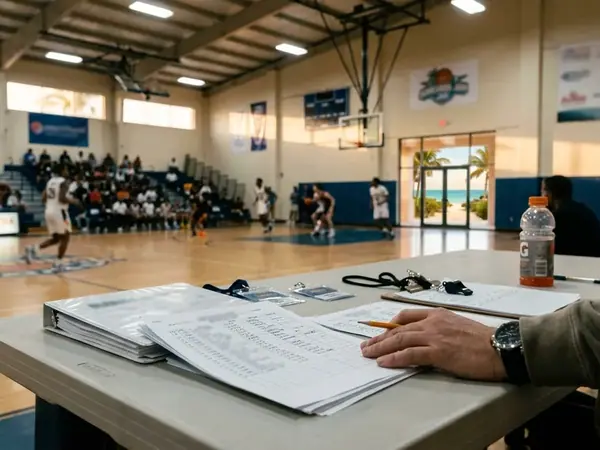
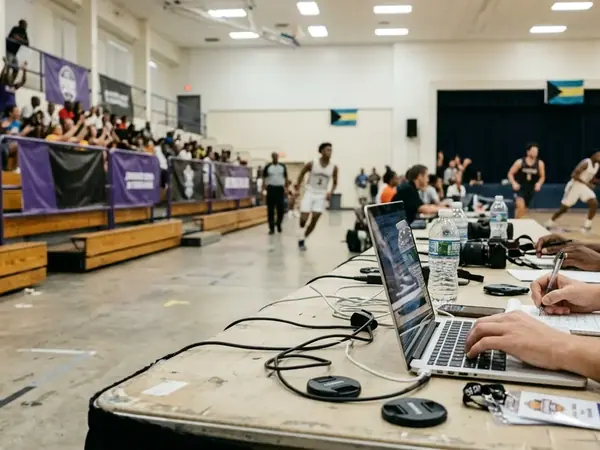
During the preseason site visit, the operations question was physical: how far would the first row sit from the sideline, and where would standing spectators constrict movement? Those details matter more to the atmosphere than an arena’s advertised capacity. A closeout looks different when the nearest fans sit only a short distance from the paint. A loose ball sounds different when the response comes from a continuous bank of occupied seats rather than from scattered sections.
The island floor made that proximity possible. Its compact footprint placed the first rows close to play while leaving little room for the empty blocks that can drain energy from a larger bowl. That was the reason to commit the women’s championship to this setting. The venue could keep defensive action, bench reactions, the band, and the traveling crowd in one shared space.
High demand for close seats strengthens that effect only when the seating plan preserves circulation. A packed baseline is valuable to the game; a blocked aisle is a problem for everyone. The useful distinction for tournament planners is between density in the seats and congestion in the routes around them. The island layout aimed for the former, with a single concourse and identifiable paths back out of the lower bowl. That choice made a clear competitive bet. Players would experience crowd responses at close range, and fans would remain connected to each possession. For an island championship with a concentrated traveling audience, the intimate bowl offered a stronger setting than a cavernous floor that spread the same audience across distant sections.
Gate Timing Set Up the Starting Lineups
Arrival began at the main gates and the alumni tunnel. Staff mapped those approaches against the pace at which the lower rows filled, especially along the benches. The point was to know when spectators would reach their seats, rather than treating an open gate as proof that the bowl was ready.
That distinction shaped the introductions. The starting-lineup reads waited until fans formed a continuous presence along both baselines. The first name then met an assembled crowd, with traveling alumni close enough to respond directly to the court. For a player stepping into a final, the introduction carried the weight of the room instead of echoing past empty patches.
Several small operational choices had to hold together:
- Keep the gate and alumni-tunnel approaches legible so arriving groups reach the correct side of the bowl.
- Watch lower-row occupancy near the benches, where late movement can distract from introductions and early possessions.
- Protect the baseline and aisle edges even as demand for the closest seats draws people toward them.
The lineup moment shows why brackets and schedules alone cannot describe a tournament experience. Tip time establishes the appointment; arrival flow determines whether the crowd is in position to take part. Here, the close stands turned introductions into the opening act of the championship rather than a ceremony occurring while people were still searching for seats.
First-Half Stops Reached Every Row
The first half established the value of the seating decision through defense. Stop-and-steal sequences broke toward the traveling alumni section, so the nearest spectators saw pressure develop and the change of possession in one sightline. With occupied rows extending from the baseline toward the band, the response traveled through the bowl without crossing a visible gap in the crowd. That is where the island arena’s acoustics mattered. A steal creates a sharp change in expectation; a transition layup gives the crowd an immediate release. Under a low roof and beside a close baseline, both events arrived as distinct sounds. The player carrying the ball could hear the reaction while the possession was still moving. The stands did not need a prompt to engage because the action unfolded directly in front of them.
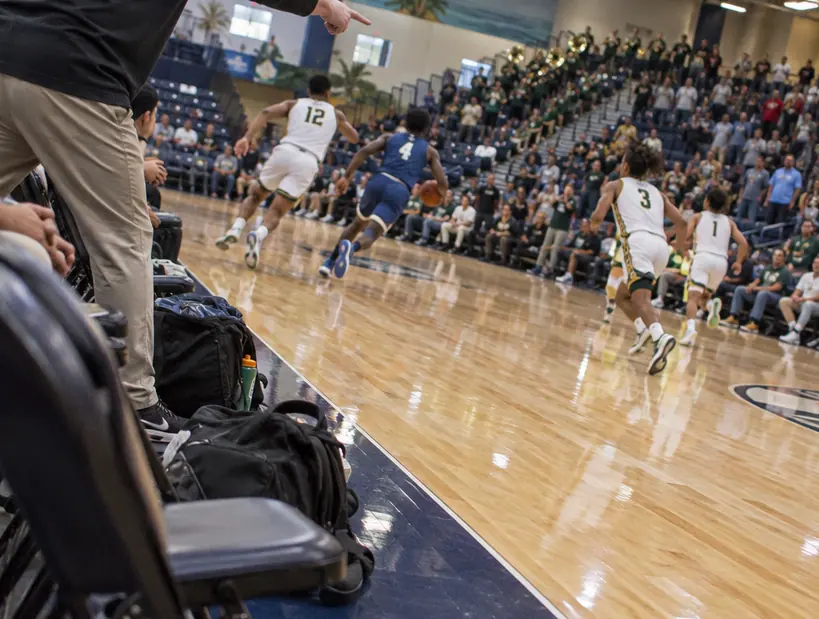
Seat checks through the early media timeout found the sections between the baseline and the inner rows occupied without empty blocks. That observation supports a narrow conclusion: the crowd nearest those defensive sequences was present and connected to them. It cannot, by itself, tell us what a particular player heard or how any single stop would have unfolded elsewhere. The useful lesson is architectural and operational. Close seating amplified a defensive sequence because the arrival plan had put people in those seats before the sequence occurred.
For fans, this changed the way the opening half read. They could follow a defender’s closeout, the turnover, and the rush toward the basket without losing the play in a distant expanse of floor. For the team under pressure, there was little acoustic separation between an error and the audience’s response. The first-half intensity came from that repeated exchange, possession after possession.
The Second-Half Run Tightened the Baseline
After the break, an unanswered scoring stretch shifted the championship’s momentum. The run matters here for its sequence as much as its size: one score increased the urgency of the next possession, and the trailing side had to restart play beneath a crowded baseline. Visiting alumni occupied the near rows, leaving inbounders with very little physical distance from the spectators behind them.
The pressure-cooker effect did not require a crowd to interfere with play. An inbounder still had the court and the rules of the possession. What changed was the surrounding field of attention. The passer faced a live defense while the crowd’s response pressed in from immediately beyond the boundary. A clean inbound gave the trailing team a chance to settle; a rushed one sent the noise back into motion.
The guards who continued attacking the rim were central to the run’s feel. Their drives brought the ball toward the close stands, where spectators could track the moment a dribble was gathered and anticipate the attempt. Each successful attack renewed the energy that the trailing team then had to carry into its next possession.
This is a useful comparison for future tournament details. A large arena can accommodate a championship crowd and still place much of it beyond the immediate play. A compact bowl concentrates reactions beside the decisions that produce them. In this final, the second-half surge made that distinction plain: the scoring side could feed on the room, while the trailing side had to execute through it.
The Final Horn Tested the Concourse
The result produced the familiar split of a championship ending: celebration at center court and a losing team moving away from the floor. Around them, the venue faced a separate test. Spectators wanted to watch, meet their groups, and leave; all of those intentions converged near the same stairs and exits.
Operations staff walked the exit ramps while the celebration remained on the court. The floor gathering stayed concentrated near center court, and the aisles remained open as the lower bowl cleared through the main doors. That separation was essential. Celebration could continue without asking departing fans to push through it, while the single-concourse layout gave staff a direct view of how the outbound crowd was moving.
A compact venue should be judged at this moment as carefully as it is judged during introductions. Full seats improve atmosphere only if people can leave them in an orderly way. Open aisles, a contained floor celebration, and a readable path to the main doors allowed the championship’s energy to carry through the final whistle without turning the exit into a bottleneck.
The recommendation follows from the full game, rather than from crowd noise alone. Future women’s tournament finals in single-concourse island gyms should favor high-density seating close to the court, with arrival and exit routes designed around that choice from the start. Put the crowd on top of the championship, keep the aisles clear, and let the game command the room.